Saturday, March 11, 2017

Sepia Saturday #358


STORMY WEATHER

Today's Sepia Saturday prompt (Thanks, Alan!) offers us a middle-aged couple, Phillip and Frederica Wylie, affectionately sharing a moment while listening to a weather broadcast on a radio in Miami Beach, FL. Now, as someone who grew up with a red transistor radio glued to her hip, who remembers when all the good songs were still being played on AM and who waited each week for Casey Kasem's long-distance dedications, I would have loved to do a Sepia Saturday post about radio.

Sadly, I have no pictures that do justice to that latent passion of mine. I don't even have a photo with a radio in it.

So ...

Let's talk about weather.

It stands to reason that if the Wylies are living in Miami Beach and they're glued to the weather broadcast, then there's probably a storm brewing. And we all know that if there's a storm brewing in Florida, it usually gets a name and a big spiral on the radar map to call its own.

June 22, 1972. I didn't live in Florida; I lived smack dab in the middle of Pennsylvania. But Hurricane Agnes didn't discriminate; she barreled up the Eastern Seaboard with a vengeance, leaving death and destruction in her wake. My little hometown, situated on the banks of the Susquehanna River, didn't stand a chance.


The photo above was taken by my father from the little bit of dry land where the end of my street met the four-lane highway that ran through town. There was a creek which ran just to the north of my housing development, and its overflowing waters extended the river's reach in this part of town. 

Ten inches of rain fell in a matter of days, and by the time it was over, entire communities had been destroyed. My parents had a radio on top of the refrigerator in the kitchen, and every day at noon my father would come home for lunch. And every day, while eating lunch, they listened to the news on WKOK out of Sunbury, PA. That June, I can remember the reports of the storm and the flooding -- Sunbury is another river town and it received extensive damage, as well. Harrisburg, the state capital, was hit hard, too; even the Governor's Mansion was under water:


Cleanup was a long and arduous process. The receding floodwaters left knee-high mud in its wake, (photos of which, surprisingly, I could not find on the internet) and the damages totaled $2.1 billion, an astronomical sum at a time. Today, that would equal over $12.2 billion. My parents were lucky. Living where they did, the most they suffered was a few inches of water in our basement and some time off work. Others weren't so fortunate.


And what did fashionable 7 year olds wear when venturing forth to view flood damage? Only the latest in print polyester pants and waterproof rain gear.


Just FYI, on June 24, 1972 the #1 song on Billboard's Top 100 was Sammy Davis Jr's "The Candy Man." My little red radio also played "Heart of Gold" (Neil Young), "A Horse with No Name" (America), "Doctor My Eyes" (Jackson Browne) and "Rocket Man" (Elton John). 

I'll leave you with this, another 1972 classic:


For more Sepia Saturday fun, click HERE!!

Monday, December 5, 2016

Sepia Saturday #346


Two days late and waaaay too many dollars short ...

Alan's December 3 prompt, along with Deb Gould's post in response to the prompt, had me immediately thinking of the childhood anticipation of Christmas. Just like summer vacation from school seemed to last a lifetime, the wait from Thanksgiving until Christmas seemed to go on interminably. Of course, back then the Macy's Thanksgiving Day parade was a real, much lauded thing and the arrival of Santa Claus at the end of the parade heralded in the Christmas shopping season (unlike now, when it often preceeds the arrival of the Great Pumpkin). And one thing every anxious child pestered about was the setting up of the Christmas tree.


Now, as long as I can remember, my parents had an artificial Christmas tree, which meant that it could be set up and decorated anytime my father got tired of my constant whining and pleading and gave in. Believe me, I was an expert at Christmas Tree Whining, a genetic anomaly that I have since passed on to my younger daughter, who has turned it into an art form. Over the years, my mother had various themed trees, depending on whim and "fashion," from monochromatic bows-n-balls, to birds, to a mishmash of collectibles. In turn, my trees have been a combination of real and artificial, with no theme whatsoever. But no tree I have ever seen, or ever even imagined, has quite equaled my Grandma Shaffer's.


This is me, Christmas 1966.


And this, in the corner of the photo, is what she affectionately called "The Umbrella Tree."

The umbrella tree was exactly what it sounds like: the carcass of an old umbrella, fabric removed, set up in a tree shape and decorated with tinsel garland and Christmas balls. Easy to set up, easy to take down, and unique in every way. We know this quirky little tree dates back at least as far as the 1950s, because my sister remembers it as a child, too. We don't know if my grandmother ever had a "real" Christmas tree, but the one she had was certainly memorable! 

Today, it makes its home with my cousin -- I don't know if he ever sets it up, or if it's in a box somewhere in his attic and he just doesn't have the heart to throw it away. But I sincerely hope that at least once he will decide to bring it out and dust it off, and set it up for his grandchildren to wonder at. 

As Dean Martin sang, "Memories are made of this."

For other Sepia Saturday posts, click ==> HERE!

Friday, May 1, 2015

Day Five: To the Victor Belong the Spoils

This is what I have left after a week of Living Below the Line ... a half bag of Uncle Ben's. Slightly more than half a bag, actually, since I only cooked two cups dry and I still have some of that left, too. Tomorrow I'll make some, lengthy, insightful post about what lessons I'm taking away from this experience (and all flippancy aside, I have learned quite a bit). But for now, in these closing hours of the challenge week, I just want to mention a few of the physical changes I've noticed in myself after living like this for five days.

~~Most days, when meal time rolled around, I ate way too fast. And it was very hard to slow down, because there was this little voice in my head squealing "OMG! Food!" like a toddler on a sugar high. Of course, just like your mom always warned you, when you eat too fast you end up with a tummy ache. And I did. Frequently.

~~The lack of vegetable fiber (and other things, I'm sure) caused a definite change in the way my digestive system processed food.

~~The caffeine withdrawal headache finally disappeared by Wednesday evening.

~~Lethargy, although I'm not certain how much of that was nutritional and how much was lack of caffeine. It's surprising how much coffee and tea actually sustain me. Thank goodness I'm not a soda drinker or it could have been worse.

~~I didn't notice a marked decrease in cognitive abilities until today, when things like being more forgetful than normal, having to recount things three or four times because I kept losing count or wouldn't get the right number, making lots of simple mistakes that shouldn't have been an issue all made an appearance. It was frustrating to look at someone I've known for years and not only call them by the wrong first name, but completely forget their last name, Not cool.

I believe I had it slightly easier than some who've taken this challenge simply because I had a little bit more food at my disposal this week. The buying power of the dollar in the rural area where I live is stronger than in other, more urban areas. If I lived in a city -- London, NY, Los Angeles -- I would have had a horrific time feeding myself even half as well on $1.50 a day. Nonetheless, I went to bed hungry, got up hungry, and by the third day thoroughly disliked almost everything I had to eat. It may have filled my stomach, even if only temporarily, but it never satisfied.

But isn't that the point? No matter where you live, big city, small town, rural village, $1.50 does not provide enough nourishing food and drink to sustain you in a healthy fashion. Eventually your body begins to suffer. There are so many children in this world who live below the extreme poverty line. They may try to go to work or to school hungry, or they may not even have those options. Someone needs to help give them those options. Someone needs to help feed them and nourish them and give them hope for a brighter future. Because these children, these little ones who are stricken with hunger and disease and who never learn to read and write, they are our future. They deserve to have a future, one without pain and suffering.


Please consider a donation. Even a few dollars will help. And if you can change the life of one child, then this has all been worth it.

You can donate by clicking ==> HERE! 

Thursday, April 30, 2015

Day Four = Turn Four

I'm not a NASCAR fan, but I've been exposed to the sport enough over the years to be fairly well-versed in the lingo. Today, for me, is the equivalent of Turn Four on the race track. I'm coming into the homestretch and the finish line is in sight. 

But what if you aren't the race leader? What if you aren't even in the lead lap? What if you're so many laps down that it's doubtful you'll even actually finish the race, stuck in the "left-turn-left-turn-left-turn" rut, with no hope of pulling ahead? 

Okay, I've exhausted the metaphor, but you see my point, right? I get to finish this five-day race, but for millions of children around the world, extreme poverty has wrecked them beyond hope. 

I skipped breakfast today, not an unusual occurance for me, especially if I'm busy. But I didn't skip a meal because I was distracted, I skipped it out of necessity because, despite what I thought was careful planning, I find myself running out of food. I had planned on eating whatever was left from the week for dinner tomorrow evening, but I found that I would have only been left with plain brown rice and a few slices of bread. Yes, I could have had toast, but by eliminating a meal and shuffling some ingredients around I can actually have my last pack of ramen with my last remaining egg, stir fried together.  

Even with so little left, I still have options. So many people the world over just don't have options. they run the race, but never gain in the rankings, never get ahead, never cross the finish line. I want to help give them options. I want to help break the left turn cycle. Won't you please join me? Even a small donation -- the equivalent of the cost of tomorrow's lunch -- can be enough to make a difference in the life of a child. And don't we all deserve a shot at the winner's circle? 

Wanna help? Clicky ==> HERE!

Wednesday, April 29, 2015

Humpday ... Two More to Go

Not that I'm counting down or anything, mind you. But tonight it was all I could do not to lick the glaze off my plate after eating. That would have been extremely uncouth. And unproductive, as it wouldn't have garnered me much in the way of edible mouthfuls anyway.  
So, what did I learn today? 

I don't want to talk about food anymore.

It's amazing, really how much of our lives, at least here in the US, are consumed with the making, eating, discussing, photographing, blogging about,and filming of food.  We create competitions around it. We earn awards for it. We go to special schools to learn how to prepare it exceptionally well. There are whole television channels devoted to the exploration of it.  We are told by the government how to eat healthy, and we are told by a myriad of "best selling" self-help gurus how to eat to lose weight, land that perfect job, romance Mr/Ms Right or improve our sex life with the significant other we already have. 

Food is everywhere, and it isn't until you can't partake in it that you become more sensitive to its proliferation. And today was the first time that listening to people discuss food began to bother me. Usually, for me, that kind of thing is easily ignored. The last two evenings I've sat beside people eating honey bourbon smoked sausages and fried chicken with only minor salivation. But the longer the week drags on, the more sensitive I become to what others have and, more specifically, what I do not. 

How discouraging it must feel to someone who doesn't have the money to participate in the overwhelmingly rampant consumerism found in a country such as the US. For someone below the extreme poverty level, who might be lucky to have a peanut butter and jelly sandwich, it could be emotionally as well as physically devastating.  

There's a light at the end of the tunnel for me. But for millions of people around the US and around the world, this just isn't the case. Won't you please join me in helping to end the disparity? Won't you please consider even a $5 or $10 donation? Every little bit helps, and if together we can change the life of one child, then this week will have all been worth it. 
You can donate online HERE.

Tuesday, April 28, 2015


Raw carrots and I share a rather jaded past. While most people I know would wholehearted grab a handful when on a diet or when wishing to eat something a bit healthier for lunch than Doritos or Butterscotch Krimpets, I personally would favor the more neglected vegetables on the tray -- broccoli, cauliflower, cucumbers, etc. But as I sit here at my kitchen table on the downward slide towards the end of day two of Living Below the Line, I can honestly say that I have never, ever tasted anything sweeter. 

I'd also like to confirm, in case there was any doubt, that I really don't like brown rice all that much. Especially by itself. 

Brown rice was my staple of choice for lunch today, along with some cooked mixed vegetables tossed in. But the vegetables didn't stretch nearly far enough and I had leftover rice which I either had to eat or be hungry. I actually threw some away. The rice I had eaten, coupled with the water I'd been drinking all day, lay congealed in my stomach like a glob of library paste. 

Sorry. Unpleasant and inappropriately graphic. Or is it? For so many people, just a simple staple like that brown rice is all they have to eat for a meal, maybe for the only meal they'll have on any given day. No vegetables. No meat. No seasoning. Just rice, or whatever they can get their hands on. I reached a point today where I was done eating, regardless of the fact that I was still hungry. I knew there would be some kind of alternative waiting for me when I got home. And the carrots, despite the fact that they normally only get 3.5 stars out of 5 from me, are right now the best tasting things in the world. 

But if all I had was that one meal ...if I didn't have that $0.29 bag of carrots in the crisper ... would I honestly look forward to the next meal? Extreme poverty robs you not only of the nutrition your body needs to remain healthy and survive, but it also robs you of variety, and of choice. Please help me bring health and nutrition and choice to those in need. Your donation, no matter how small, can help ensure that a child gets much needed food, as well as medicine, vaccines and educational supplies. Won't you please help make a difference in the life of a child?   

Want to help make a difference in the life of a child? Visit my Live Below the Line page HERE to make your donation, no matter how large or small. All help is greatly appreciated!

Monday, April 27, 2015

Day One: A Lesson in Moderation


As far as first days go, today wasn't too bad.Slight headache this evening, which I expected, since I actually quit caffeine cold turkey on Saturday, so this is Day Three without my morning cup of personality. Because I was able to procure inexpensive eggs, I had eggs and toast for breakfast, which helped though. Lunch was ramen and my afternoon snack was some carrots. 
By the time I got to eat dinner, which consisted of four of the little potatoes and half the can of pork-n-beans, I was hungry but not ravenous. I counted the slices of bread in the loaf ... if I get hungry tonight I can have a piece of toast as a snack, but unfortunately I don't think that can be an every night occurance or I'll run out of bread before the end of the week. 

Moderation. 

A friend of mine in Southern California took my purchase list and did a price comparison in her local grocery store. Now, I have to admit, I tried to get as much "bang for my buck" as I possibly could, choosing straight-from-the-coop eggs and canned goods from the local bent-n-dent. Her purchase total was a staggering $20.67 as compared to my $7.31. Incredible. Which means if I find this challenging here ... 

According to UNICEF, 22,000 children die each day due to the ravages of extreme poverty. That is a shocking and heartbreaking statistic. So many young lives, so much suffering, so much wasted potential. Who knows what those young minds could have produced had they received the proper nourishment, healthcare and education.

Want to help in the fight against extreme poverty? Visit my Live Below the Line page HERE to add your support.

Saturday, April 25, 2015

Round Two ... and I'm Broke!


Second round of Live Below the Line shopping this afternoon completed. I went to a local bent-n-dent and did well, I think. A loaf of whole grain bread for $1.00, a bag of brown rice for $1.00, a pound bag of frozen mixed vegetables for $0.99, a can of pork & beans for $0.39, a can of southern seasoned black eyed peas for $0.50, a can of seasoned diced tomatoes for $0.40 and a pound brick of margarine for $0.50. Total spent today was $4.78, for a grand total of $7.31.That means maybe one day this week I can splurge on a cup of coffee or a cup of tea with the extra $0.19.

The menu is all planned -- I think what will be the hardest to deal with is the lack of variety. Nothing flavored to drink at all. No meat, no spices or seasonings other than what's in the beans and tomatoes. I can imagine how having to deal with that every day indefinitely could quickly become discouraging.  And I'm very fortunate in that I live in an area where the cost of living is lower than in some places around the country and around the world. A friend of mine who lives in southern California said that she absolutely could not see how anyone in the Los Angeles area could survive on $1.50 a day. Here in rural Pennsylvania, our incomes may be lower but things cost less and our money stretches a bit further than it does in more urban areas. Nonetheless, it's still a challenge.

Want to help end extreme poverty? Visit my page HERE and lend your support with an online donation, or leave me a comment if you want instructions on how to send a check.

Friday, April 24, 2015

The First Round of Shopping ...

... is done. I've had lots of helpful suggestions from friends and co-workers, for which I'm very grateful. So far I have a dozen eggs for $1, three packs of ramen for $0.45, a bag of baby carrots for $0.29 and a bag of potato "fingerlings" for $0.79. $2.53 spent, $4.97 to go.
Want to donate to help end extreme poverty?
https://www.livebelowtheline.com/me/patty

Thursday, April 23, 2015

Living Below the Line


Psyching Myself Up to Live on $1.50/Day

I have often joked about things being a "first world problem." But over the last six months or so, I've found myself often assessing a situation using that very criteria. Having worked with the public most of my adult life, I've been afforded the opportunity to listen to my share of complaints and whining. And there have been times when I had to bite my tongue to keep from saying, "Do you understand how privileged you really are?" I have to remind myself of this, too, when I fall into the complaining trap -- when I whine because I'm frustrated with my cell phone and vow to get the one I really want next time; when I grumble because I live too far out of town for takeout deliveries; when I roll my eyes and grit my teeth because my internet connection is slow. 

First world problems. 

There have been times in my life where my family has lived paycheck-to-paycheck and that paycheck hasn't stretched quite far enough. We "robbed Peter to pay Paul" and did without any of the extras just so that we could buy groceries. Thankfully, we never fell below that extreme poverty line and we have recovered to a place where we are comfortable now. Perhaps that's why this campaign resonates so much with me -- because when I was at my lowest, when anxiety and worry kept me from sleeping at night -- it was the hopelessness that weighed on me the most. I never saw a light at the end of the tunnel. I want to help those who suffer from extreme poverty see the light at the end of the tunnel. I want to help give them hope that someday things will get better. I want them to know that someone cares. 

What is Live Below the Line? It's a campaign to fight extreme poverty worldwide. By agreeing to eat and drink on $1.50/day for five days, you help bring awareness to the ravages of extreme poverty and those who suffer because of it. There were several charities to partner with, and I have chosen to partner with UNICEF, a long-standing and well-known organization devoted to bringing relief to children and their families by providing food, vitamins, vaccines, clean water, educational materials and disaster relief.

I'm not going to lie ... next week is going to be difficult. I've already started planning out my menu and I've made a basic shopping list. I'm lucky that I live close to a bent-n-dent grocery store where I can purchase foodstuffs for cheap so my $7.50 will stretch just a bit further. Items are hit-or-miss there, so I have no idea what I'll find when I go shopping but I'm looking forward to that challenge, too. I know my week will end up being very carb-heavy, which is not something I'm used to, but I already know I'm getting fresh eggs for $1.00/dozen, which is fabulous, and a pound bag of frozen mixed vegetables for $0.99. Ramen is only $0.15 each and I can get a couple of bananas for $0.39/lb there. Cans of beans are $0.40 each. Rice can be had for less than a dollar. Oh, and a loaf of bread ... I may hit the regular grocery store day-old shelf for that, if they have any. 

So, having preached about first world problems, (sorry about that, by the way) will I keep my smartphone and my internet? Of course I will. And next week will be a tangible reminder of what's important and where my priorities should lie.

Want to donate and help me fight extreme poverty? Please visit my LBTL page HERE.

Tuesday, February 3, 2015

Today's forgotten Word-of-the-Day (thanks to The Word Museum):

bird-duffer

A dishonest dealer in birds who "makes up" his wares, 
either by painting the plumage of live birds
or by fabricating bird skins, affixing false labels, etc.


Hard to believe this happened often enough to warrant its own word. 

However, I immediately thought of this video.  I give you the best visual reference of a bird-duffer that you will ever see:


Gotta love those Pythons. They set the standard. Best. Ever.

Sunday, August 18, 2013

Yaz's Rules for the Road

Today's guest blog post is brought to you by Yazzer the Beagle, who has some great tips on canine etiquette for making those outings with your human more memorable:

1 ~ First and foremost, even if you love car rides, resist getting in the car. This sets an immediate tone for the outing and lets the attending human know who's really in charge. Pace beside the car with your nose to the ground, pretending to sniff everything, while making sure the mud left by the heavy rain thoroughly coats your paws. This is especially effective if the car has cloth seats.

2 ~ Once in the vehicle, prance enthusiastically from window to window, leaving multiple nose prints on all glass surfaces. Climb from the back seat to the front. Be sure to drool on the dashboard, the door panels and any personal items within your reach. If the driver does not consider this "Dog Art" but instead is squicked by the slobbery mess, be sure to lick your nose often before pressing it to the glass. This will help the driver more easily appreciate your talent.

3 ~ While leaving snot-graffiti on the door windows, be sure to stand your front paws on the power window button. Lower the window enough to stick your head out and sniff the wind, then shift your weight and close the window on your snout. Yelp loudly. This causes the car to swerve while the driver fumbles frantically to free you.

4 ~ Be sure to perch on the edge of the seat so that when the driver brakes, you slide off and tumble head-first to the floor. This produces additional swerving (see #3) and possibly swearing as the driver attempts to rescue you from your calculated misfortune. Try to keep your head tucked under the glovebox/compartment, thereby making it infinitely more difficult for your human to retrieve you. Bonus points for clawing the driver.

5 ~ Let the driver know that their car isn't the only thing with a smelly exhaust. Car rides, while exciting, may give you digestive distress. Share your discomfort with others. Repeatedly. Works especially well in conjunction with #4 to add insult to injury,

6 ~ If the driver is dropping off a passenger, whimper pathetically when the passenger exits the car. Struggle to escape. If you find yourself still inside the vehicle, whine and bark loudly for at least five full minutes, allowing your vocalizations to echo smartly in the confines of the enclosed space. This puts your human on a state of High Alert, as evidenced by their white-knuckled grip on the steering wheel, and warns them that you are immeasurably displeased.

7 ~ When those feelings of passenger drop-off rejection become too overwhelming, attempt to find solace by forcefully climbing into the driver's lap, seating yourself between their torso and the steering wheel, and staring imploringly into their face, nose-to-nose. This is especially effective if you weigh fifty pounds or more and haven't been considered a lap dog in at least two years.

8 ~ Finally, when returning home, climb over the driver as you seek your freedom, being sure to press your full weight into any sensitive human tissue in your path. It is imperative that you DO NOT let the driver exit the vehicle first. If, despite your best efforts, the driver does manage to get out of the car ahead of you, dive between their feet before they manage to stand fully upright, thereby tripping them. Then put your snout in the air and strut into the house with buckets of swagger. After all, you are a dog.


Yaz is a 5 year old pure-bred beagle who lives with his partner in crime,Timber, and several humans. Despite a previous owner's ill-advised name choice synonymous with faulty birth control, Yaz has a burgeoning dog's life. His best known work to-date is Upsetting the Christmas Tree and Poo-ing in Becky's Work Shoes. His current project is Sneaking Food Wrappers Out of the Trashcan Without Anyone Noticing.  He writes from Shippensburg, PA.

Sepia Saturday #190


I must begin this week's post with a heartfelt apology. It has been well over a year and a half since I have either participated in Sepia Saturday or visited the posts of other Sepians, and I have sorely missed it! While I could wax poetic about the greed of the modern schedule or the elusiveness of time, I will instead simply make my post as if the gap year didn't really exist.

Of course, I'm still posting these on Sunday. Some things just can't be helped.

This week's photo prompt shows four fashionably dressed young ladies having a picnic in the grass.  Sadly, I have no personal family photographs of picnics or outings to share. Growing up, my immediate family (and extended family, as well) didn't seem particularly inclined toward outdoor celebrations of any kind. "Too much work" and "too many bugs" were just two of the excuses I remember hearing. And from the definite lack of evidence to the contrary, it would seem The Fam came by that inclination honestly -- there are no photographs of such family activities back through three or four generations. 

That doesn't mean I come to the party empty-handed, however!

In working with my local historical society, one of the projects I have begun is identifying some of the dozens and dozens of unknown photographs in our collection, such as the above image.  While the names are lost, the image is nonetheless fabulous! I love the formality of the fashion and the table setting, even though the event is outdoors in a tent. Speaks volumes about the nature of the dining experience a century ago - there's even a vase of fresh-cut flowers on the table. Whatever the occasion, it's obvious that this gathering is incredibly elaborate, unlike the more spontaneous picnics on the grass.

Come see what other Sepians have posted by clicking ==> HERE!!


Wednesday, February 29, 2012

A Piece of My Youth ...

... is gone. Davy was my first "Hollywood" crush.

I think my heart is breaking.


Sunday, February 26, 2012

If These Walls Could Talk

After having lived in our 140-year-old house for over 20 years, I was under the impression that we had discovered just about all the house's secrets that were meant to be discovered. We know exactly how cold it has to get before we need to put a heat lamp under the kitchen sink to keep the pipes from freezing. We know to check for leaks in the spare room upstairs when the driving rain comes from the west. We know that too much rain or snowmelt in March will cause flooding in our cellar. We know when someone starts the dryer because the kitchen light dims.

You get the idea.

But while all those quirks give an old house character (and the homeowner some frustration), it's the history and anecdotes and stories from previous owners which, added together, give a house personality.

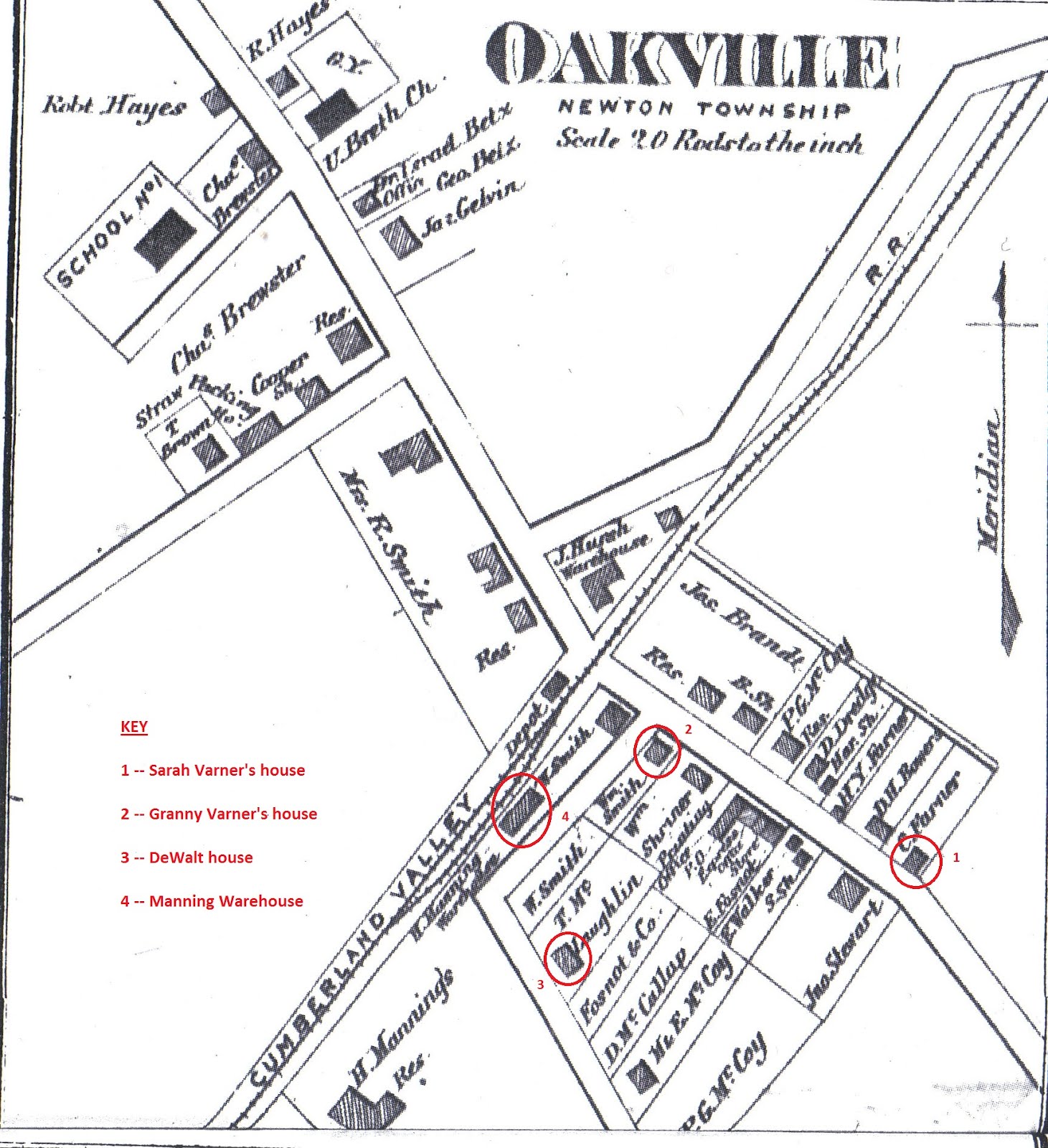
I've seen maps and photographs of the house through the years, proving that it's led an interesting life. But all of the former owners have moved away or passed on, as have many of the old neighbors, and so I have no collected stories about my house, save my own. At least, I didn't until the November meeting of my local historical society. The presentation that night was entitled, "Murder in Oakville," and I'd attended with anticipation, eager for a good tale about my little village and expecting the crime to have been committed in one of the houses across the street, which is purported to be haunted.

You can see where this is going, can't you?

Yup. My house. Yellow crime scene tape, detectives in long overcoats chewing pen caps. All right ... not really. They didn't have yellow crime scene tape in 1885. But there was lust and jealousy and, in my opinion, a bit of set-up for the man who was killed. Let's start with the actual crime itself.

Daniel Clever, aged 42, and his brother William lived about four miles from Oakville on adjoining farms. William Martin, aged 20, was a farmhand for both farmers, but was currently living with his younger sister, Ida, on the William Clever farm. On May 2, 1885, Daniel sent his wife, Annie, about aged 25, and their infant daughter, Dora, along with his sister to visit a friend, Sarah Varner, who lived in Oakville. When it was time for the evening meal, Annie went up the street and retrieved Elizabeth Varner, Sarah's grandmother, so she might dine with them. When the meal was finished, Annie insisted on returning to Granny Varner's house to spend the night. The old woman argued with her, asking Annie to remain with her granddaughter and her husband's sister, as she had been ill for some time and wasn't up to keeping overnight company. But Annie refused to be persuaded and left her sister-in-law to bed at one end of the block, while she and her daughter set off to retire at the other end with Granny. Before leaving, she asked Sarah to send for her in the event her husband should arrive in the morning before she returned.

Meanwhile, back on the farm, the evening meal commenced. For whatever reason, Daniel was at the store and not present at table, so his brother, who knew that his sister-in-law and the farmhand had been secretly talking and flirting with each other for some time, first asked young William Martin if her knew that Annie had traveled to Oakville, and then told him that he need not finish the plowing that evening if he had somewhere to go. Set free, young William immediately went to Oakville, where Annie had asked him to meet her.


Having sent the young man off, William Clever set the upcoming tragic events in motion. Seeking out his brother, he was observed having a long, animated conversation with him. Daniel then sent a lad into the church which Martin attended. Upon finding out he was not there, Daniel proceeded to ride to a nearby farm under the pretense of finding out if Martin was visiting a girl there. When the answer was again negative, Daniel rode, not to Sarah Varner's house, where he had sent his wife to visit, but straight to Granny Varner's house.

In the meantime, things had gotten interesting at Granny's house. After having forced the old woman to take her in, Annie had Granny make up a bed for the child while she opened the kitchen window and the shutters so she could keep watch. After a few minutes, she told Granny that there was someone at her door, and when the elderly woman opened the door, she was surprised to find William Martin. She didn't say anything at first, for fear that something had happened at the farm and Martin had been sent to retrieve the young wife. But when Annie next told the old woman to take Dora and go to bed, Granny realized the couple's intention and she refused to leave them alone. Annie wouldn't be deterred, however, and in an incredibly selfish move, took the lamp from Granny and led Martin into the adjoining room, shutting the door behind them and leaving Granny and the infant in the dark.

Granny spent the next few minutes struggling to find a fat lamp and light it. No sooner did she have that accomplished then there was yet another knock on the door. This time, it was Daniel Clever seeking his wife. When he learned that not only was Annie there, but behind closed doors with Martin, he pulled out a pistol and, in a blind rage, kicked at the door until it gave way. He then shot three times into the room. Young Martin ran out the back door and collapsed in the neighbor's yard, where he was found by several neighbors and taken first to the DeWalt workshop and then to the warehouse office owned by Mr. Manning.

Inside the house, Annie chastised her husband for shooting at the boy. Daniel said little, but instead set to work repairing the door that he'd damaged. Annie insisted that she liked Martin and he liked her, and Granny scolded her for her foolishness. Daniel said he should have shot her instead and threatened to take the child and leave her, but in the end he took both his wife and his child home, without seeing Martin again or checking to see if the farmhand still lived. Once home, Daniel sent his wife into the house to retrieve his overcoat, then left her and the child there and roused his brother, William. They rode to the neighboring Justice of the Peace, where Daniel confessed to having shot William Martin and transferred his property to his brother in preparation for his flight to Canada. The JP tried to talk Daniel into turning himself in, but Daniel refused.

Back in Oakville, the physician was sent for, but Dr. Israel Betz refused to treat the young man until he confessed who shot him and why. It would appear that Dr. Betz held out little hope for the gunshot victim's survival anyway, and told him as much. Ida Martin was sent for, and she returned her brother to her parents' home, where he died two days later, May 4, 1885. Daniel Clever consulted a lawyer and turned himself in to authorities three weeks later.

In a trial that began August 27, 1885, the jury found the defendant, Daniel Clever, not guilty of murder by reason of insanity.


If you're interested, the transcription of the trial is part of the Harvard Law Library's Studies in Scarlet Virtual Collection, and can be found at http://vc.lib.harvard.edu/vc/deliver/~scarlet/004031139. Just click on the URL link marked Digital Object. The Studies in Scarlet Collection contains over 420 individual trial narratives for cases involving domestic violence, bigamy, seduction, breach of promise to marry, child custody, rape and murder from 1815 through 1914.

The transcription makes for fascinating reading because you get a real taste of century-old court drama. And it is drama! The prosecution took approximately thirty pages to make their case. It's very straightforward and factual. Daniel Clever killed a man, he admitted he killed a man. Hang him. The end. But the defense takes over one hundred and fifty pages to paint the portrait of a man who had complete faith and trust in home and hearth, a church-going man who suspected no hint of wrong-doing on the part of his deceptive wife and who, once shown the reality of the situation, went mad with grief and anger. Her betrayal drove him to the edge of insanity. I haven't made it the whole way through the transcription yet, but the defense's opening statements are impassioned and emotional, designed to tug on the jury's heartstrings in a way that mere facts alone cannot do. And according to the speaker who gave the presentation, the defense went on to show that others in Daniel's family exhibited that genetic predisposition towards less mainstream behavior. In other words, they were all crazy!

And I'd love to know exactly what role the brother, William Clever, played in all this. I still think it was a set-up, I just don't know why. Was he trying to protect Daniel? Or was there some other, more sinister reason he betrayed the young couple's affections? More research is needed, definitely.

So now I have a fun story to tell about my house! I wonder what else these walls could tell me, if only they could talk.

Saturday, February 25, 2012

The Acquisitions Department Strikes Again!

As a neophyte antiques collector, I don't often have the disposable income to purchase those wonderful items which catch my eye. But I also consider myself a bargain hunter, and I'm proud to say that my most recent additions didn't cost me a dime, just a bit of labor on the part of my Dear Hub to wrestle them out of their former home.

This is my favorite new item:

Looks pretty grungy, doesn't it? Taken from the basement of the financial institution where I currently work, this piece is actually two separate sections. The bottom cabinet has shelves and some large cubbyholes for storage. But what really made me fall in love with it was ...


... the top section, which opens to reveal dozens of little cubbies!! The individual slots themselves actually have dates on them, and this was used to organize bank documents, etc. There's a twin to this upper section in the original bank vault which is in the basement of the building, but that twin is anchored to the wall of the vault and has extensive mold and insect damage. This one was free standing and kept in a separate, drier part of the basement. The dates are in the 1930s, so it's entirely possible that this part was in use up until the original financial institution was bought out after being in business for almost a hundred years. The cabinet does need a good bit of TLC:

There's some places where the wood needs repaired, too, but I think once we're finished, this will be an exciting piece to own! I can't wait to get started on it!!

Also from the depths of the old bank vault:


A step stool for reaching the higher shelves. This also needs some sprucing up, but it, too, will be a really nice piece once it's repaired.

There were dozens and dozens of old ledgers both in the vault and just stacked in the basement, some dating as far back as the bank's inception in the 1860s. Everything paper found inside the vault will be shredded, as it has mildew throughout. But some of the old books in other parts of the basement were salvageable:


This small one serves a dual purpose. The front section, as indicated by the front flyleaf, is a list of who owns stock in the bank and how many shares they have. I've searched for the word "apepment" in both regular and financial dictionaries, to no avail. I'm assuming it means distribution or ownership, but I'll keep looking for an actual definition. Notice the date -- July 28, 1863.

The back section of that ledger is an accounting of bank notes issued and destroyed, including dates and denominations.

The medium-sized ledger is a book of transient deposits, beginning with the date 1867.

Love the fancy pensmanship!

The biggest ledger is in the best shape, probably because it's the newest. The first date is April 15, 1943.

It's a receipt book of stock sales. Again, I love the signature!

He could have taught his successor how to write. Things got a bit sloppy in 1950!

There was also a very large, very heavy leather and corduroy binder:

The leather needs cleaned, but the embossing on the side is still crisp and really nice.

The rings of the binder open with a key. No, unfortunately we don't have it.

I also picked up an old empty coin box. They don't ship coin like this anymore!


So, those are all my new "finds." It looks like I have some work to do, but I'll definitely post photos of the cubbyhole cabinet once I get it finished.

And I must report that Yazzer, while impressed with the wealth of bank antiques brought into his home, was nonetheless disappointed none of them were edible. Poor puppy!

Sunday, October 23, 2011

Sepia Saturday #97

THERE'S ONE IN EVERY CROWD

Happy Sepia Saturday! ... er ... Sunday! ... uh ... Saturunday!!

Alan's prompt this week was a wonderful photo of some Irish schoolchildren being adorably candid and child-like, with quite a few of them looking everywhere BUT at the camera.

It immediately brought to mind this photo:
This charming group of clowns is part of a May Day celebration in my hometown, dated 1956. Notice some of the clowns are smiling, some have their arms crossed in a tough guy stance, almost all of them are looking at the camera, and all the little clowns have their faces painted. Well, all except one, back row, second from right. Yes, one lone clown apparently defied conformity and decided she wasn't going to participate like all her classmates. Like I said, there's one in every crowd.

Because it's turning cold here, I'll veer off away from children and follow the path to a warmer theme ...

The celebration of May Day on or close to May 1 was a tradition in my home school district for many years. There was a theme each year, with events for elementary, junior high and high school students. There was even a May Day Queen, chosen from the junior class, and her court. This photo is from our high school's 1939 yearbook, and the queen was a classmate of my mother's. In later years, the girls had male escorts, decked out in tuxedos, selected by the teachers.

And what would a May Day celebration be without a May Pole? I have no idea what you had to do to be selected for this ritual. Note the bare feet, although I don't see any Beltane fires burning in the school gym. While the celebration of May Day is an ancient tradition in many parts of the world (May 1 was actually considered the first day of summer, which made the summer solstice, June 21, mid-summer) the practice died out in the 1960s here where I live.

Now I'm off to check out the rest of the Sepia Saturunday participants. Come join me by clicking HERE!

Oh, one more thing ... that defiant little clown, the one who didn't want her face painted? That's my sister! And yes, she still acts that way. Shhhh ... don't tell her I said that.

Sunday, October 9, 2011

Sepia Saturday #95

(I guess I'm going to have to start calling these "Sepia Sundays" since I keep posting a day too late!)

A BANNER TOPIC

Alan's photo prompt for this week's Sepia Saturday was reminiscent of suffragettes and parades, and we were invited to select a theme. I chose the theme of "banners," and in so doing I offer the following:

The Chamberlin Building in Lewisburg, PA circa 1910. The banners and other patriotic decorations are to celebrate an I.O.O.F. convention. Two different stores occupied the commercial space in the "Iron Front Building" as pictured here, a general store on the left and a shoe store on the right. Built in 1855, the building, with a cast iron over brick facade, was also home to the Independent Order of Oddfellows, the Red Cross, county welfare, a hardware store and an electrical supply store. The building still stands today and is on the National Register.

In the next block, more buildings are decorated in a similar fashion, although the photo is undated. From the left: a grocery store, hardware store, pharmacy, and a dry goods store.

This is the Saturday News newspaper office, circa 1918, decorated to celebrate the end of WWI. The paper was owned by Benjamin Focht, who served as both a PA State legislator and as a US Representative. Given the relative size of his banner, it would seem politicians were ostentatious back then, too!

And finally ...
The Banner Store! Built in 1835, it housed, in its lifetime, the above dry goods store, a jewelry store and a drug store, among others. I remember it being a men's clothing store where my father often purchased clothing and accessories, long before the advent of mega-huge shopping malls and the internet.

For more variations on a Sepia Saturday theme, clicky ==>> HERE!!

**Photo of the Chamberlin Building is part of a private collection. Photo of Market Street buildings is in the Packwood House Museum collection. The Saturday News and the Banner Store photos are from the Union County Historical Society collection. Information about the buildings is from the book "Lewisburg" by Marion Lois Huffines and Richard A Sauers, part of the Images of America series by Arcadia Publishing. Buy the book here. It's fabulous, as are other books in the Images of America series.

Sunday, October 2, 2011

Sepia Saturday #94

"Willing Hands to Save"

Grabbing onto the theme of 'horses' from Alan's photo prompt, I decided to share the story of William Cameron's Silsby Steamer.


William Cameron was born in Lancaster County, Pennsylvania in 1795, the oldest of eight children. The family moved to Lewisburg, PA in 1810. During his lifetime, William served in the War of 1812, was Justice of the Peace, had a dry goods business, and then started the Lewisburg Savings Institution, which eventually became the Lewisburg National Bank. The bank was run out of William's home for 34 years before acquiring its own building. While William was well-known locally in his own right, his brother, Simon, had a claim to national fame, as he had served as a Pennsylvania Senator, as Lincoln's Secretary of War from 1861-1862, and then as Ambassador to Russia from 1862-1865.

Needless to say, William was a very wealthy man. In February 1874, he gifted the town of Lewisburg with a much-needed piece of fire equipment -- the Silsby Steamer.


Purchased from the Silsby Manufacturing Company of Seneca Falls, NY, the horse-drawn Steamer was a coal-fired water pump able to build enough pressure to shoot water 175 feet over the spire of the Baptist Church, and was delivered along with 2,500 feet of hose and three hose carriages for the then-impressive sum of $10,000. A parade was formed the day of delivery which started at the firehouse and included the Lewisburg Silver Cornet Band (I wish I had a photo of that!), the newly appointed Chief Engineer Samuel D. Bates, the Steamer itself and all its accoutrements, and "Little Valiant," the old hand-cranked pump which tried its best to serve the community but was now a broken relic. The parade, with over 1,000 spectators and participants, ended up at Squire Cameron's house, where he made the following speech:

Gentlemen of the town council of the borough of Lewisburg - I am happy to present to you for the citizens of Lewisburg the steam fire engine, hose carriages and hose now before you. And let me say to you, this is not the first time I have thought of making some gift to the Boro of Lewisburg. I had intended making an entirely different one; but when I saw the steam fire engine exhibited here a few weeks ago, and found the people were so strongly in favor of council purchasing one like it, the idea struck my mind that here was an opportunity to make a gift which would give more real pleasure or lasting benefit than a steam fire engine and the necessary accompaniments.

From the large outpouring of the people on this occasion and the very many expressions of kindness, I believe the people are satisfied, and my heart is rejoiced to feel that this is the case.

If in the future I am the humble means, through this gift of saving a single tenement of a poor family in or about Lewisburg, I will feel extremely thankful. I now turn over the steam engine and the accompanying apparatus to the town council to keep as the property of the citizens of Lewisburg.


In return, the town renamed the fire company the William Cameron Engine Company. William died three years later, in September 1877.


Although not uncommon to see horses on the streets of Lewisburg well into the 1930s, the Silsby Steamer was finally retired from service in 1932, a 58-year veteran of the fire company. Pictured above is the next generation of fire equipment to serve the community. Notice the double doors on the front of the building have been replaced with a single, wider door to accommodate the larger engines, and the original wooden floor was replaced with poured concrete. This firehouse was eventually torn down in the 1960s along with the residence beside it, and a newer, larger firehouse was built at the engine company's present location. The old property is now a municipal parking lot. (On a personal side note, the church to the very right of the picture was where I was married in 1988.)

The current building, Company 2:


Both the Silsby Steamer and its predecessor, Little Valiant, are currently on display at the WCEC's Liddick-Stephens Museum.


NOTE: The title of today's post, "Willing Hands to Save," is the motto of the William Cameron Engine Company.

**All black-and-white photos in today's post are part of the collection of the Union County Historical Society. Color photos are courtesy of the William Cameron Engine Company. William Cameron's speech along with other historical tidbits can be found on the William Cameron Engine Company's website.


For more of this week's Sepia Saturday fun, clicky RIGHT HERE!