You get the idea.
But while all those quirks give an old house character (and the homeowner some frustration), it's the history and anecdotes and stories from previous owners which, added together, give a house personality.
I've seen maps and photographs of the house through the years, proving that it's led an interesting life. But all of the former owners have moved away or passed on, as have many of the old neighbors, and so I have no collected stories about my house, save my own. At least, I didn't until the November meeting of my local historical society. The presentation that night was entitled, "Murder in Oakville," and I'd attended with anticipation, eager for a good tale about my little village and expecting the crime to have been committed in one of the houses across the street, which is purported to be haunted.
You can see where this is going, can't you?
Yup. My house. Yellow crime scene tape, detectives in long overcoats chewing pen caps. All right ... not really. They didn't have yellow crime scene tape in 1885. But there was lust and jealousy and, in my opinion, a bit of set-up for the man who was killed. Let's start with the actual crime itself.
Daniel Clever, aged 42, and his brother William lived about four miles from Oakville on adjoining farms. William Martin, aged 20, was a farmhand for both farmers, but was currently living with his younger sister, Ida, on the William Clever farm. On May 2, 1885, Daniel sent his wife, Annie, about aged 25, and their infant daughter, Dora, along with his sister to visit a friend, Sarah Varner, who lived in Oakville. When it was time for the evening meal, Annie went up the street and retrieved Elizabeth Varner, Sarah's grandmother, so she might dine with them. When the meal was finished, Annie insisted on returning to Granny Varner's house to spend the night. The old woman argued with her, asking Annie to remain with her granddaughter and her husband's sister, as she had been ill for some time and wasn't up to keeping overnight company. But Annie refused to be persuaded and left her sister-in-law to bed at one end of the block, while she and her daughter set off to retire at the other end with Granny. Before leaving, she asked Sarah to send for her in the event her husband should arrive in the morning before she returned.
Meanwhile, back on the farm, the evening meal commenced. For whatever reason, Daniel was at the store and not present at table, so his brother, who knew that his sister-in-law and the farmhand had been secretly talking and flirting with each other for some time, first asked young William Martin if her knew that Annie had traveled to Oakville, and then told him that he need not finish the plowing that evening if he had somewhere to go. Set free, young William immediately went to Oakville, where Annie had asked him to meet her.
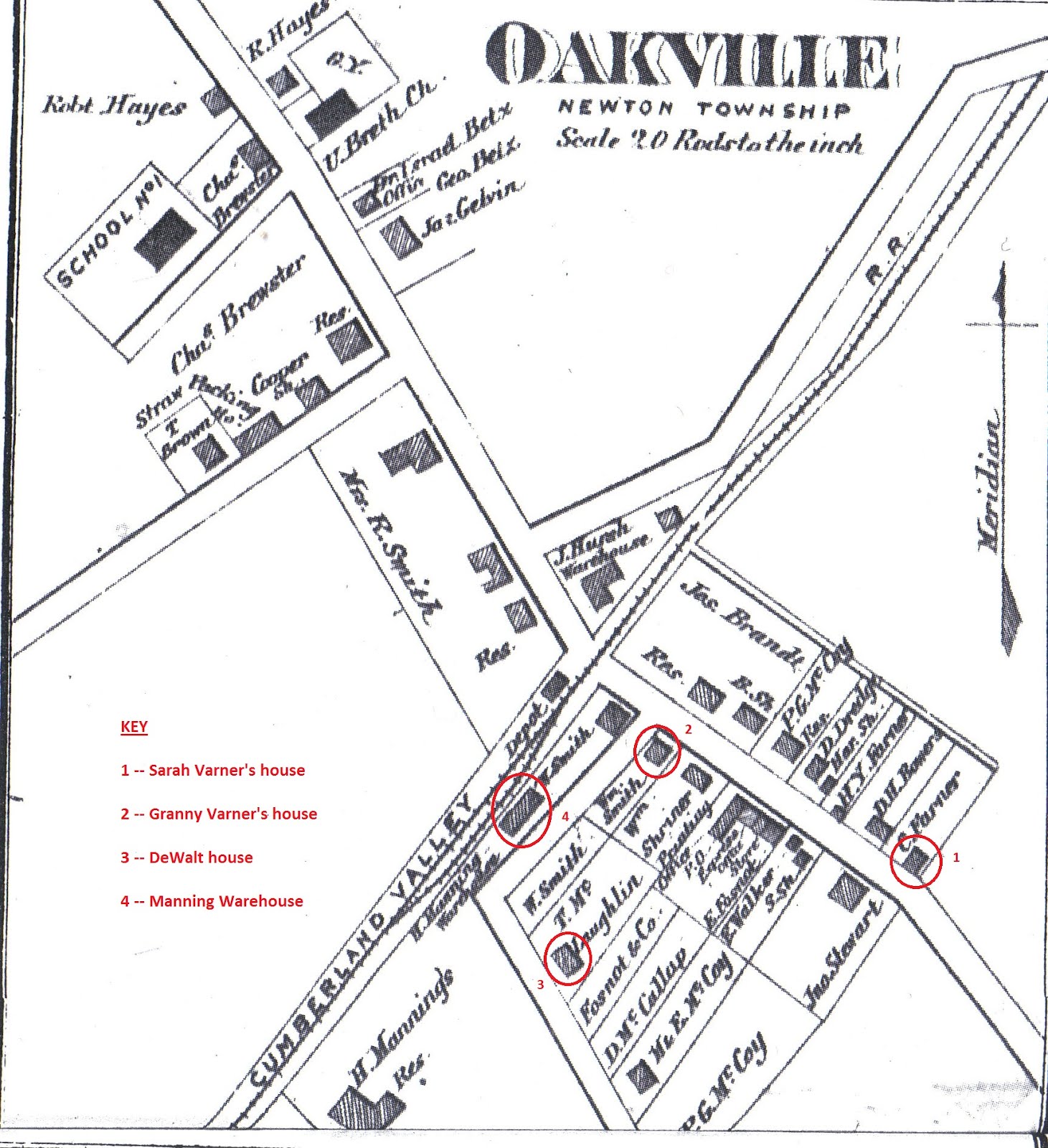
Having sent the young man off, William Clever set the upcoming tragic events in motion. Seeking out his brother, he was observed having a long, animated conversation with him. Daniel then sent a lad into the church which Martin attended. Upon finding out he was not there, Daniel proceeded to ride to a nearby farm under the pretense of finding out if Martin was visiting a girl there. When the answer was again negative, Daniel rode, not to Sarah Varner's house, where he had sent his wife to visit, but straight to Granny Varner's house.
In the meantime, things had gotten interesting at Granny's house. After having forced the old woman to take her in, Annie had Granny make up a bed for the child while she opened the kitchen window and the shutters so she could keep watch. After a few minutes, she told Granny that there was someone at her door, and when the elderly woman opened the door, she was surprised to find William Martin. She didn't say anything at first, for fear that something had happened at the farm and Martin had been sent to retrieve the young wife. But when Annie next told the old woman to take Dora and go to bed, Granny realized the couple's intention and she refused to leave them alone. Annie wouldn't be deterred, however, and in an incredibly selfish move, took the lamp from Granny and led Martin into the adjoining room, shutting the door behind them and leaving Granny and the infant in the dark.
Granny spent the next few minutes struggling to find a fat lamp and light it. No sooner did she have that accomplished then there was yet another knock on the door. This time, it was Daniel Clever seeking his wife. When he learned that not only was Annie there, but behind closed doors with Martin, he pulled out a pistol and, in a blind rage, kicked at the door until it gave way. He then shot three times into the room. Young Martin ran out the back door and collapsed in the neighbor's yard, where he was found by several neighbors and taken first to the DeWalt workshop and then to the warehouse office owned by Mr. Manning.
Inside the house, Annie chastised her husband for shooting at the boy. Daniel said little, but instead set to work repairing the door that he'd damaged. Annie insisted that she liked Martin and he liked her, and Granny scolded her for her foolishness. Daniel said he should have shot her instead and threatened to take the child and leave her, but in the end he took both his wife and his child home, without seeing Martin again or checking to see if the farmhand still lived. Once home, Daniel sent his wife into the house to retrieve his overcoat, then left her and the child there and roused his brother, William. They rode to the neighboring Justice of the Peace, where Daniel confessed to having shot William Martin and transferred his property to his brother in preparation for his flight to Canada. The JP tried to talk Daniel into turning himself in, but Daniel refused.
Back in Oakville, the physician was sent for, but Dr. Israel Betz refused to treat the young man until he confessed who shot him and why. It would appear that Dr. Betz held out little hope for the gunshot victim's survival anyway, and told him as much. Ida Martin was sent for, and she returned her brother to her parents' home, where he died two days later, May 4, 1885. Daniel Clever consulted a lawyer and turned himself in to authorities three weeks later.
In a trial that began August 27, 1885, the jury found the defendant, Daniel Clever, not guilty of murder by reason of insanity.
If you're interested, the transcription of the trial is part of the Harvard Law Library's Studies in Scarlet Virtual Collection, and can be found at http://vc.lib.harvard.edu/vc/deliver/~scarlet/004031139. Just click on the URL link marked Digital Object. The Studies in Scarlet Collection contains over 420 individual trial narratives for cases involving domestic violence, bigamy, seduction, breach of promise to marry, child custody, rape and murder from 1815 through 1914.

The transcription makes for fascinating reading because you get a real taste of century-old court drama. And it is drama! The prosecution took approximately thirty pages to make their case. It's very straightforward and factual. Daniel Clever killed a man, he admitted he killed a man. Hang him. The end. But the defense takes over one hundred and fifty pages to paint the portrait of a man who had complete faith and trust in home and hearth, a church-going man who suspected no hint of wrong-doing on the part of his deceptive wife and who, once shown the reality of the situation, went mad with grief and anger. Her betrayal drove him to the edge of insanity. I haven't made it the whole way through the transcription yet, but the defense's opening statements are impassioned and emotional, designed to tug on the jury's heartstrings in a way that mere facts alone cannot do. And according to the speaker who gave the presentation, the defense went on to show that others in Daniel's family exhibited that genetic predisposition towards less mainstream behavior. In other words, they were all crazy!
And I'd love to know exactly what role the brother, William Clever, played in all this. I still think it was a set-up, I just don't know why. Was he trying to protect Daniel? Or was there some other, more sinister reason he betrayed the young couple's affections? More research is needed, definitely.
So now I have a fun story to tell about my house! I wonder what else these walls could tell me, if only they could talk.


 Posts
Posts


